Communicable Diseases
Description
This course provides a comprehensive foundation in the principles and practices related to communicable diseases, equipping participants with essential knowledge and practical skills to understand, prevent, and control infectious threats to public health.
Participants will explore the global and regional burden of communicable diseases, their causative agents, and transmission dynamics. The course delves into the life cycle of infectious organisms, the role of environmental and social determinants, and the epidemiological basis for intervention strategies. It emphasizes both traditional and emerging infectious diseases—including vaccine-preventable diseases, vector-borne infections, zoonoses, respiratory pathogens, and sexually transmitted infections.
The course also addresses disease surveillance, outbreak investigation, infection prevention and control measures, and laboratory safety. Special focus is placed on aligning communicable disease control efforts with the Sustainable Development Goals (SDGs) and strengthening health systems through effective public health programs.
By the end of this course, participants will be prepared to contribute to communicable disease prevention and control at local, national, and regional levels using evidence-based and context-specific approaches.
Learning Outcomes
- Identify major communicable diseases of public health importance and assess their global and regional burden.
- Recognize the common causative microorganisms and vectors responsible for infectious diseases.
- Describe the transmission pathways and life cycles of key communicable diseases and apply this knowledge to inform prevention and control strategies.
- Analyze the environmental, social, and behavioral determinants influencing the spread and persistence of communicable diseases.
- Apply the levels of disease prevention (primary, secondary, and tertiary) in designing appropriate public health interventions.
- Evaluate various control approaches, including surveillance, vaccination, vector control, health education, and infection prevention and control.
- Interpret basic epidemiological data related to communicable diseases using surveys and surveillance systems.
- Demonstrate awareness of infection control practices at both foundational and advanced levels, including laboratory biosafety.
- Discuss specific categories of communicable diseases, including vaccine-preventable diseases, vector-borne diseases, zoonotic infections, sexually transmitted infections including HIV/AIDS, respiratory infections, and tuberculosis.
- Introduction to communicable diseases
- Burden of communicable diseases
- Transmission dynamics and life cycle
- Determinants of communicable diseases
- Levels of prevention
- Control approaches
- Introduction to Vaccine-Preventable Diseases (VPDs)
- Outbreak Investigation and Response for Vaccine-Preventable Diseases (VPDs)
- Introduction to Vector-Borne Diseases
- Vector Control and Integrated Vector Management (IVM)
- Emerging infections: SARS, MERS-CoV/ coronavirus and influenza
- Microorganisms and Infection
- Effective Hospital Infection Prevention and Control Program
- Surveillance System
- Hand Hygiene Compliance
- Introduction to Microbiology.

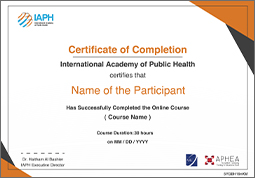
Certificate